ASTERSAAR ARCHIPELAGO
A set of isles and skerries off the North Ilican Coast, towards Edjer Highlands, named after the abundance of aster flowers on their shores. In hues of blue, pale violet and even rarely white, they bloom betwixt the rocks and any which skerry, even where naught else grows.
GEOGRAPHY & NATURE
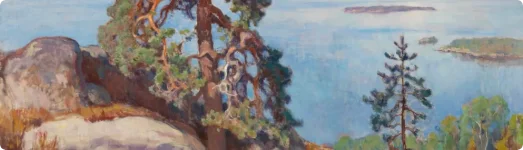
The archipelago is composed of four habited isles, the largest, Astersaar, being the hub for it’s social events, trade and other traffic. The three smaller isles, Kalkrona, Lasaretinkari and Alderholma, arch off from it in an eastward circle, a mile or two apart. The area of open water in their midst, Asterfjärd, is shortened to merely Fjärd by the islanders. It is on all of them spoken of as its own entity separate from the rest of the sea and is a relative direction to its own (fjärdways or -wards).
Astersaar, Alderholma and Kalkrona are very similar betwixt one another in appearance. The ground rises rapidly after the barren, wind-beaten beaches, billowing forms of lichen patched rock mixing with forest and meadow, and the occasional freshwater pond or bog. Some of the taller pines, birch and spruce have been left betwixt buildings for shelter and to bind the shallow earth, though many of the plants have developed phenotypes more resistant to the strong winds. They grow horizontally, crawling, sticking closer to ground.

For it’s relatively long distance from the continent, the wildlife on the archipelago isn’t terribly varied in larger mammalian life, save for the couple fabled times a moose or deer has managed to swim to the isles. A number of roe mingle with the free-roaming sheep and other livestock during the summers, but mainly keep to the smaller, unhabited isles that trail off to distance. Birds of all sizes are in abundance, be it to permanently habit the hollows and branches or staying just the little while on their way somewhere else. The nesting of a particularly large flock of swans is a treasured occurence on Alderholma, taking place yearly in the shelter of its western cove. None shall stray there, allowed to only watch their beauty from afar.
Alongside the range of seabirds, from gulls to any which duck, the water around the isles offers a bounty of fish, seals and some cetaceans, majorly porpoise that use their small size to maneuver betwixt the skerries. The sea isn’t very deep on average around the isles, rife with creeping rocks and shallows, but does have the occasional deeper point. The greater underwater sinkholes are subject to stories, the likes about paths to seconds seas beneath the first one or monsters that should favour the darker and colder water. Even swimming above them is a regular dare amongst the youngsters, just as scaling the lone tall rocks or singing to the ghosts of sailors when the mist rolls in.
CULTURE & ECONOMY
Just as the fauna and flora, the houses are generally squat and of simple proportions, made of axehewn logs propped upon foundations of stone, mainly granite and migmatite. Limestone, quarried at Kalkrona, is no longer used at the isles due to it’s value, but used to be — the remnants of this practice remain in the feet of older houses and columns of spiritually significant sites, many weatherbeaten but still recognizably light in colour. Some smaller rubble and other shards from the quarries are still used to line flowerbeds or mark out paths, for purposes both storied and decorative. The mineral dust also makes great fertilized for backyard gardens, but is bartered for and never freely given.
These days the majority of the stone is sold and ferried to mainland, be it raw or as marble and other derivatives, enabling trade for things and materials that the islanders fail to produce on their own. Grain is one of them, as the isles’ soil for the most part lacks in both depth and unified surface area required by extensive farming. The other important imports are spices, medicine, metals and all manner of finery, as there is very little local production for any of them. Salt is extracted from both seawater and by burning turf soaked in it, but hardly to a measure that’d make it an actual export. Astersaar as a harbour and shelter for ships does, however, serve the overseas salt trade at large as an important rest stop.
By virtue of all this trade, travel and tale, a distance that doesn’t beget isolation, the archipelago hosts a varied bunch as its people. For this there is tradition and culture that, while recognizably Astersaarian, is malleable in its minutia. Many of the holidays and meanings of symbols are shared, just as domestic rituals and other gestures, but actual spiritual commitment is varied. Feasts for lost sailors or turn of season, offerings under thresholds or visitations to desolate islets, local legends and the tales that warn children off the skerries. None of these are written down, all learned over a lifetime, but it depends on the person whether they’ll fault a stranger for breaking code.
Beyond the less spoken of things a couple practices stand out even to whom should visit for but a day. Each of the isles has its own colours that lay painted on the piers and wayposts, along with a more specific directional indicator. These compose into a collection of lines by which to navigate, mainly for benefit of those who yet suffer getting lost or are visiting. Other than function, these stripes have a decorative purpose and it is employed more whimsically in all manner of ways, be it in windchimes of coloured driftwood, woven details about a ryijy or regional garb for means of identity.

The mysticism bound to both sea and sailing has also given form to folk arts, motifs lent by the surroundings and sailors that craft their embroidered garments on long voyages. These are realized anew in domestic textile crafts, mainly out of wool that is refined to both woven and knit goods. While most clothing and items are simple, for utility and keeping in mind the expense of materials, plain they are not — needlework on the seams, hems, collars and cuffs, thinbrushed detail on finer tableware, colourful tablet-woven ribbons attached to just about anything for an extra touch of home. The patterns and techniques for all this are passed on during the colder winter months and every decorated article produced in the home, so their quality and further inspirations are personalized to say the least.
LASARETINKARI
Or just Kari, for short, is the smallest of the four isles and the most barren. From the distance it appears to the unwitting as nothing more than a glorified rock with a triptych of buildings nestled in the hollow of a crescent forest, with a dash of cultivation in its fenced up gardens and orchards. But one road leads inland from the rocky shore and most only get to tread it the once. It is customary to bring your own coffin, or enough timber for one.
The three buildings compose the lasaret, dedicated to the permanently sick and dying. The lepers, the blighted, the occasional unfortunate case that was sent off on mere suspicion of either, or worse — abandoned with nowhere else to go. Residences vary in their time, from three years to a decade, all in equal accommodations. A bed, a chest for personal effects and the supervision of a small team of caretakers. The doors are not locked and on the small pier always floats a boat for any which errand, but none ever leaves. Only the staff pick on the oars and set the sailcloth fjärdward for the other isles, on their yearly leaves.
But hear, creeping juniper at the shore yet hums with a wind and the sun shines on the gardens. And the sailors and fishermen both come, to peddle for what brews in the forest and cellars. Distilled from rye, juniper and an assortment of sixteen herbs. The gin produced on Lasaretinkari is strong and flavourful and as such recommended to not be consumed raw. Around the isles it is generally mixed with tonic and dashed with cranberries, with a length of rosemary for garnish. The seafaring folk covet it for the better grog it makes than the usual already watered down stuff found on alehouses and harbours, and how relatively easy it is to trade for. They do not ask for much, out here, but fresh fruit fetches a larger cask than all the rest.
Oranges preferred. No gold. It's not like we'll get to spend it.
Contributors: kris
Art Credit: works by Eero Järnefelt, Albert Edelfelt & Akseli Gallen-Kallela, kansallisgalleria
Attachments
Last edited: