CASTLES IN THE SKY
A continuation of ReflectionsTime, in Cellachán’s opinion, is a funny old thing.
It’s been three weeks since he arrived in Arpa. It didn’t even take him that long to get here from Cloud’s Keep: a few days by skyship into Crown’s Hold, and then a couple of weeks via the relative snail’s pace of horse-drawn carriage along winding rural roads. A fortnight and some change, and yet, all that time had dragged out to something so tediously more, it had felt like something which ought to be measured in months as opposed to weeks.
By contrast, the time he’s spent in Arpa seems to be slipping away from him all too fast. Well, that’s always how it goes when he has a project. Although this one has been a little different.
OK. It’s been a lot different.
The professor’s worked on his share of urgent, life-or-death projects before, but never actually from ground zero itself, where said threat is ticking away beneath his very feet in accordance to some infallible doomsday clock. And he’s usually worked from the insulated, well-furnished laboratories offered by Makari College. Arpa, however, does not ‘do’ laboratories. Arpa does not have state-of-the-art metallurgical, alchemical, and arcano-fabrication facilities, with teams of highly-trained specialists able to manufacture magitech components to Cel’s very exacting needs. Arpa has mud. It has mud, and mould, and rain, and a morbidly fascinating spectrum of condemned buildings, like some massive installation piece on the subject of entropy and decay. So it goes without saying that the working conditions here are a little subpar to what he’s used to.
It’s honestly been quite invigorating.
He’s never been challenged in this way before. Cellachán thought he was adept in the arts of frugality, but this is something else. Back at Makari, such a simple project would take three, perhaps four, days at most to reach this stage of trials. Here, it’s taken three weeks. Three weeks of painstaking measurements taken by hand and eye, setting up the glass furnace and lens-making equipment, producing mock blanks, grinding, polishing, experimenting with smoking and ambering agents and armonium content, testing their mock-ups to compare the refraction indices of these new materials to that of conventional optics, revising the original formulae…
And that’s just what the project has involved. Cel’s also made sure to set some of his waking hours aside for other things, because working yourself into the ground on one thing exclusively is a good way to cook your brain. As such, he’s also spent these three weeks on things which might seem, on the surface, a bit frivolous by comparison.
Yvain, the scribe who’s been assigned to him? It turns out the young man is also a tailor in the making. Cel had been wondering what the quiet fellow was scribbling down whenever he wasn’t helping with the project, and the answer turned out mostly to be: clothing patterns. This until-then reserved blond youth had opened up at Cellachán’s curiosity about the subject, and they’ve since had some rather pleasant chats. Quite a sophisticated craft, is tailoring. Something of a science, rife with intricacies which make the poor professor’s head spin, full as it already is with his own work. He appreciates their little talks, even so.
Cellachán has also made an effort to get to know Arpa, and to his relief, there’s actually a bit more to it than the mud. He usually takes a walk (during the day — he has no wish to learn first-hand why the town enforces a night-time curfew), and is now familiar enough with a few locals that they’ll stop and chew the fat whenever they cross paths. Doing that had also opened up an avenue to follow one of Walter’s suggestions; to have a look at the local burial rites. For the most part, Arpa’s populace have proven quite happy to show him. The professor has on a few occasions now been invited into a family home to look at their funeral ceramics, coated with ash glaze made from the cremated remains of their loved ones. And each time, he would be treated to stories. Fond, or formative, memories about the people he now saw as gleaming bands of fired colour. Tales about mothers and fathers, brothers and sisters. Some, about sons and daughters. Always painful, especially the latter. But the stories still came, even through the tears and choked-up throats. The need to share was stronger than the hurt. Perhaps what was left of those departed souls — sharing made what traces lingered of them in this world a little stronger. Made them feel a little less… gone.
The ash ceramics had been related to Cel as bearing some unknown, stabilising effect on the Shroud. Of course he’d been curious, and has wanted to see if he could glean some of their effect for himself. But that detached, analytical interest withered away the moment someone gently pressed the sage-green statuette of their mother into his great leathery hands. He could feel something more important than his desire for quantifiable measurements, nestled there in his fingers. So that’s the way he decided to try and understand. Not by his usual methods of dissection, but, simply by the feel of it; by the stories their families shared, the looks on their faces as they did, and the emotion in their voice. After three weeks of that, Cel feels as though he’s learned a great deal. He doesn’t know what he’s learned, exactly. But it’s there; the vague monolith which comprises all those smaller, individual elegies of the lost, yet at the same time, is greater than the sum thereof.
Besides all that, the rest of his spare time seems to be taken up with Walter Thornley.
Lord Thornley continues to prove an interesting figure. Cellachán could almost believe the man with whom he shares coffee, quiet work sessions, and the occasional dinner, is someone entirely different to the one whom the Crown has delegated to command Arpa’s restoration efforts. The bodies in the gibbets have changed over a few times now since Cel got here, and it’s common knowledge that the Baron Thornley metes out those punishments himself. That man, who holds such stony-faced counsel from the alehouse, the grim rider who leads his Huntsmen out against gods know what… it hardly seems like he could be the same fellow who trades good-natured quips and knowing smiles with the professor from across their writing table. That man always seems so relaxed, so gentle, so — so content in those moments shared with Cel. Tired, as well. It was quickly apparent that Walter has a bit of an estranged relationship with sleep, and it shows. Cel would normally urge him to take a step back from the project and look after himself, but it seems as though their time spent working together gives him a much-needed reprieve in other ways. So, their collaborative sessions continue. It certainly speeds progress along. It appears to do the Lord Thornley some good. And if the professor is being completely honest, he takes no small amount of enjoyment from it himself. He’s become rather fond of Walter’s company over these last three weeks.
And that is why Cellachán is waiting, here, at the top of the hill. Because this trial run is a momentous occasion, the first real fruits of their combined labours, and it doesn’t feel at all right to start without Walter here.
They chose the hill as one viewpoint for a few reasons, but mostly because it’s out of the way — once they begin to take readings, they will need utmost stability to complete the work. It could take days of laborious effort to completely map out these ‘towers’ from one particular angle, and subjecting the telescope even to small vibrations from foot traffic over that time could cause small yet significant shifts in alignment, which in turn would skew their readings. But the hill sees little use, and while the buildings up here are not yet truly fit for habitation, they at least offer a handful of suitable viewing platforms. Cel has chosen one of the most intact rooms in the old furniture-maker’s house to turn into such a station: he’s sealed up its gaps, while cutting out a snug view port through the ceiling which just fits the big, fat objective lens of their prototype. It’s covered over at the moment; a small brass dome has been fixed in place over the roof-tiles as a means of protection, which can be flipped open or closed via some simple pulley system within the room itself. Otherwise, once the door is closed, absolutely no other external light can find its way in. The darker it is inside, the better their experimental little camera obscura should work.
The door is not closed. Right now, it stands propped open awash in watery, overcast, second-hand daylight. A human might find the viewing room still too dim to comfortably navigate, but Cel’s night vision is superior than that (one of the few areas where his sight actually has the upper hand), so he can make out the matt smudge of its two chairs, the glass-and-metal glimmer of their prototype refracting Shroudscope and, mounted in its sturdy, very protective frame right behind the eyepiece: the darker-black oblong which is their image sensor.
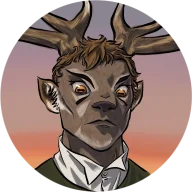
Cellachán occupies one of the chairs. He’s been occupying it for quite a while, long enough that he’s definitely starting to wish he’d brought a cushion. It’s just, he doesn’t really want to move around too much, given a) the delicate nature of much of this equipment, b) the relatively cramped confines of the room, and c) his damnably awkward antlers, which still haven’t reached the point where he can comfortably saw them off. Nonetheless. In spite of the discomfort, Cel continues to wait rather than get things over with. A little soreness is a small price to pay for being able to share this red-letter day with a friend, after all.
Last edited: